Airbnb bookings down in 2026? What hosts on Reddit are actually doing about it
Bookings are genuinely softer for many hosts, and the forums show it. But the data says this is saturation, not collapse. Here is what the numbers actually show and the moves hosts are making to fill the calendar.
By Find My Guest··5 min read
occupancydirect bookingsshort-term rental
If your Airbnb bookings feel down in 2026, you are not imagining it, and you are
not alone · but the reason is not the one the panic threads suggest. The data
points to saturation, not collapse: supply has grown faster than demand, so the
same number of guests is spread across more listings, and individual calendars
feel it first. That distinction matters, because the fix for a soft market is very
different from the fix for a dying one. Here is what is actually happening and what
hosts are doing about it.
What the forums are saying
The sentiment is real. On the official Airbnb community forums, hosts in the "Slow
Season 2025" discussions describe brutal years: one reports being "not even half as
booked" versus their 2024 peak despite refurbishing and adding discounts; another
is at "less than one-third" of a ten-year average. One host's response captures the
mood: "I just closed down rooms for now till I see prices go back to a minimal
acceptable level." (Airbnb Community).
The same worry runs through r/AirBnBHosts and r/ShortTermRentals · slow pacing,
oversupply, undercutting.
What the data actually shows
Soft, yes. Collapsing, no.
Early 2026 paid occupancy was pacing down single digits year over year · roughly
6% in January, 5% in February, 3% in March · while nightly rates held up, up 2 to
4% (Key Data).
Occupancy nationally sat around 51% in December 2025, off about 1.7% year over
year (AirDNA, via StayFi).
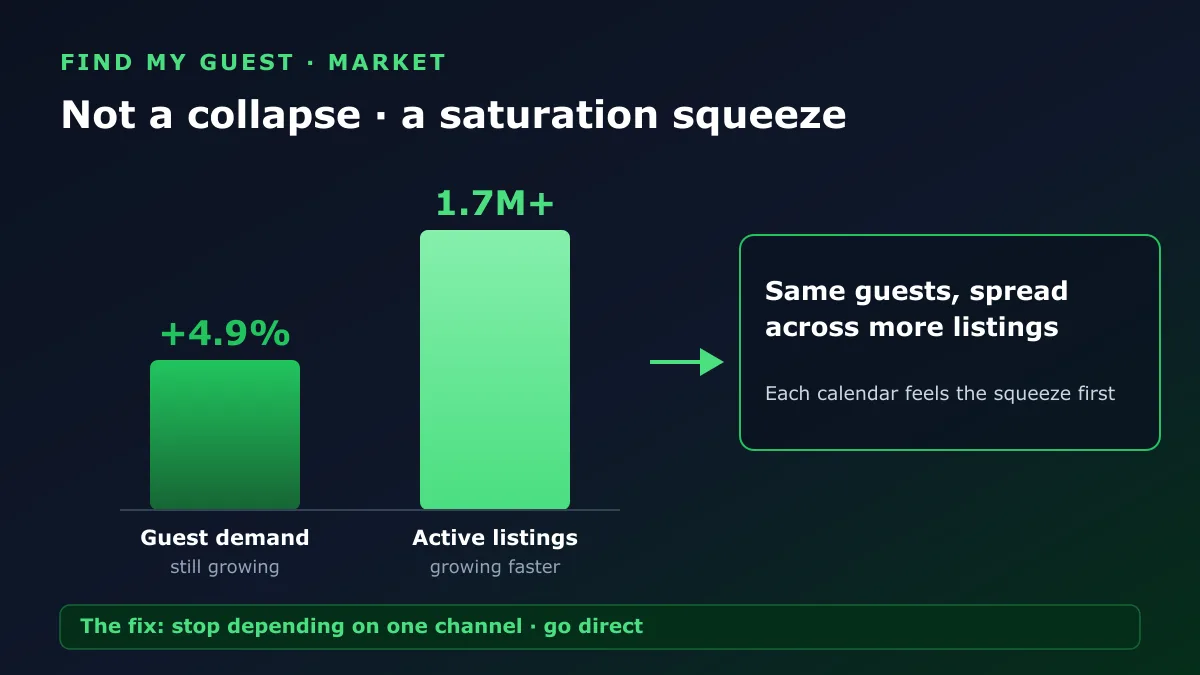
But total demand is still growing · AirDNA tracked demand up around 4.9% in
2025 · and RevPAR hit record highs even as occupancy dipped. The pressure is
supply: US active listings kept climbing past 1.7 million.
Put simply: more guests are traveling than ever, but even more listings are
competing for them. The average host feels a decline that the market as a whole is
not having. That is a distribution problem, and distribution problems are solvable.
Signal
Direction
What it means
Paid occupancy (early 2026)
Down 3 to 6% YoY
Individual calendars feel softer
Nightly rates
Up 2 to 4%
Guests still paying, no price collapse
Total demand (2025)
Up ~4.9%
More people traveling, not fewer
Active US listings
Past 1.7 million
Supply outgrew demand · the real pressure
What hosts are doing about it
The forum answers cluster into four moves, and the stronger ones are about no
longer depending on a single channel you do not control.
1. Diversifying channels. Hosts are listing beyond Airbnb · Vrbo, Booking,
Furnished Finder, local Facebook groups · and blocking calendars instead of
discounting into the floor.
2. Shifting some inventory to mid-term. A common pattern: three months of
short-term in season, longer stays the rest of the year to stabilize income.
3. Pushing toward direct bookings. This is the highest-leverage move. Direct
fell to just 21% of reservations in late 2025, meaning most repeat guests are
still re-booked through an OTA that takes 15 to 25% every time (channel and
commission data). Every
booking you move direct is margin back in your pocket. We break down why in direct
bookings vs OTAs.
4. Getting found where guests now look. A soft market rewards the hosts who are
visible in more places · Google, and increasingly AI assistants, which travelers
now use for a majority of trips. Being the answer when someone searches "family
rental near [town]" is how you win share in a crowded market instead of cutting
price.
Move
What it does
Leverage
Diversify channels
Vrbo, Booking, local groups instead of one app
Reduces single-channel risk
Shift to mid-term
Longer stays off-season to stabilize income
Steadier cash flow
Push direct bookings
Re-book repeat guests on your own site
Saves 15 to 25% per stay
Get found on Google and AI
Be the answer when guests search
Wins share without cutting price
The last two are where our audit helps: we check whether your own site is
findable on Google and AI, then hand you a prioritized, developer-free plan so more
of your demand arrives direct.
The takeaway
Bookings being down in 2026 is mostly a saturation story, not a bust. Guests are
still traveling · they are just choosing among more options. The hosts filling
their calendars are the ones who stop relying on one algorithm to feed them, get
visible across Google and AI, and pull more of their bookings direct. That is a
market you can compete in, not one you have to wait out.
Good to know
Are Airbnb bookings really down in 2026?
+
For many individual hosts, yes · early 2026 paid occupancy paced down single digits year over year. But total guest demand is still growing, so this is saturation from more listings competing, not a market collapse.
Is the Airbnb bubble bursting?
+
The data does not support a burst. Demand rose around 4.9% in 2025 and RevPAR hit record highs even as occupancy dipped. The pressure comes from supply · US active listings climbed past 1.7 million · which is a distribution problem, not a dying market.
What are hosts doing when bookings slow down?
+
The forum consensus is four moves: diversify beyond Airbnb, shift some inventory to mid-term stays, push guests toward direct bookings, and get found on Google and AI assistants. The strongest ones stop depending on a single channel you do not control.
Why do direct bookings matter in a soft market?
+
Direct fell to just 21% of reservations in late 2025, so most repeat guests are re-booked through an OTA taking 15 to 25% each time. Every booking you move direct is margin back in your pocket and one less booking that depends on someone else's algorithm.