← Back to the blog

Is the Airbnb bubble bursting? The honest Reddit take, and what still works

The Airbnbust meme is back on Reddit every slow season. We checked the doom against the actual market data. The truth is less dramatic and more useful, and it points to exactly what still works for hosts.

By Find My Guest4 min read
short-term rentaldirect bookingsmarket
Is the Airbnb bubble bursting? The honest Reddit take, and what still works

Short answer: no, the Airbnb bubble is not bursting · but the market has matured, and that feels like bursting if you are an individual host getting squeezed. Demand is still growing and revenue per available rental has hit record highs; what has changed is that supply grew faster, so more hosts share the same guests. The "Airbnbust" is largely a recurring internet mood, not a data event. Understanding that changes what you should do about it, so let us separate the panic from the numbers.

Where the panic comes from

The "Airbnbust" story has a real origin. In 2022 a host posted to a Superhost Facebook group that his California property had gone from 80% occupancy to zero · "we haven't had a single booking since June" · and it spread across Twitter and Reddit into a full-blown meme (TIME). It resurfaces every slow season. There is also a real guest-side backlash on r/AirBnB about cleaning fees, add-on charges and rules, which outlets have covered as "Reddit wants to cancel Airbnb" (The Manual). Both are genuine sentiment. Neither is a market forecast.

What the market data actually says

The numbers tell a calmer story:

  • Demand is still rising · AirDNA tracked around 4.9% demand growth in 2025 · and RevPAR reached all-time highs even as occupancy softened (AirDNA, via StayFi).
  • Occupancy has slipped a point or two year over year (around 51% late 2025), and early 2026 pacing is down single digits, with nightly rates still up 2 to 4% (Key Data).
  • The real pressure is supply · US active listings pushed past 1.7 million · so the guest pool is spread thinner even though it keeps growing.

That is the signature of a maturing market, not a collapsing one. Early gold-rush occupancy is gone; a normal, competitive business remains. The hosts who struggle are usually the ones still running the 2021 playbook of "list it and they will come".
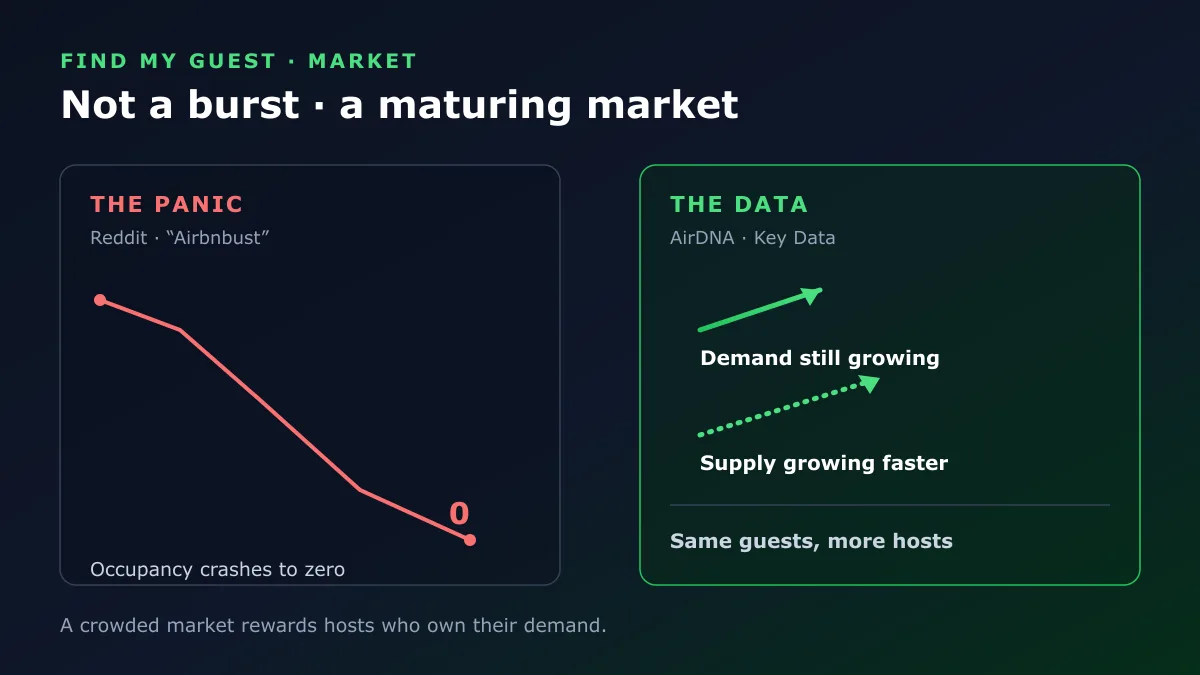
The panic imagines occupancy crashing to zero; the data shows demand still growing while supply grows faster, so the same guests are shared by more hosts

Side by side, the Reddit narrative and the market numbers barely overlap:

Signal The Reddit panic What the data shows
Demand Guests have vanished Still growing, around 4.9% in 2025
Revenue Hosts are going bust RevPAR at all-time highs
Occupancy Crashed to zero Softened a point or two, near 51%
Root cause The bubble burst Supply grew faster than demand

Here are the same metrics with actual direction and magnitude, so you can judge the trend rather than the mood:

Metric Recent trend Reading
Demand growth +4.9% (2025) Market still expanding
RevPAR Record highs Revenue per rental is strong
Occupancy ~51%, down 1 to 2 pts Softer, not collapsing
Nightly rate +2 to 4% Pricing power intact
Active listings Past 1.7M Competition is the real pressure

What still works

In a crowded market, the winners are the hosts who control more of their own demand instead of renting it from an algorithm. Three things still work, and arguably work better now than they did in the easy years:

Own your guest relationship. Repeat and referral guests do not care about the Airbnb algorithm. Yet most repeat bookings still flow back through an OTA taking 15 to 25% each time. Moving them direct is pure margin · see direct bookings vs OTAs.

Be findable off the platform. When occupancy tightens, visibility on Google and AI assistants is how you win the guests who never open Airbnb. Travelers now use AI for a majority of trips, and a good direct site is exactly what those assistants prefer to point them to.

Compete on being the obvious answer, not the cheapest. Strong, specific reviews and a clear site let you hold rate instead of racing competitors to the bottom.

That first-and-second point is what our audit is built for: we check whether guests can find you on Google and AI without going through an OTA, and give you a prioritized plan to fix it.

The takeaway

The bubble is not bursting · the training wheels came off. A maturing short-term rental market rewards operators, not tourists of the trade. Stop waiting for the "bust" to reverse, take ownership of your discovery and your guest relationships, and a crowded market becomes one you can quietly win share in.

Good to know

Is the Airbnb bubble actually bursting in 2026?
No. Demand is still growing and revenue per available rental has hit record highs. What changed is that supply grew faster than demand, so more hosts share the same guests. That is a maturing market, not a collapse.
What is the Airbnbust?
It is an internet meme, not a market event. It traces back to a 2022 post from a host whose occupancy dropped to zero, which spread across Twitter and Reddit. It resurfaces every slow season as a recurring mood rather than a forecast.
Why does hosting feel harder if the market is not crashing?
Because US active listings pushed past 1.7 million while occupancy slipped a point or two. The guest pool keeps growing but spreads thinner, so an individual host competing on price alone feels squeezed even though the overall market is healthy.
What should hosts do about a saturated market?
Control your own demand instead of renting it from an algorithm: move repeat guests to direct bookings, stay findable on Google and AI assistants, and compete on being the obvious answer rather than the cheapest.

Keep reading