Direct bookings vs OTAs: 7 reasons to win more of them
OTAs like Airbnb and Booking take 15-20% of every stay and keep your guest at arm's length. Here are seven reasons direct bookings win · commissions, repeat guests, pricing, data and referrals · plus how to get more.
By Find My Guest··5 min read
direct bookingsOTAscommissions
Online travel agencies (OTAs) like Airbnb, Booking.com and Vrbo are great at one
thing: putting you in front of travelers who have never heard of you. That is
worth paying for. The mistake is stopping there · treating the OTA as your only
channel, when direct bookings are where the real margin and the real
relationship live.
A direct booking is simply a guest who books through your own site instead of a
platform. Here is why you want more of them.
1. You stop paying 15-20% in commission
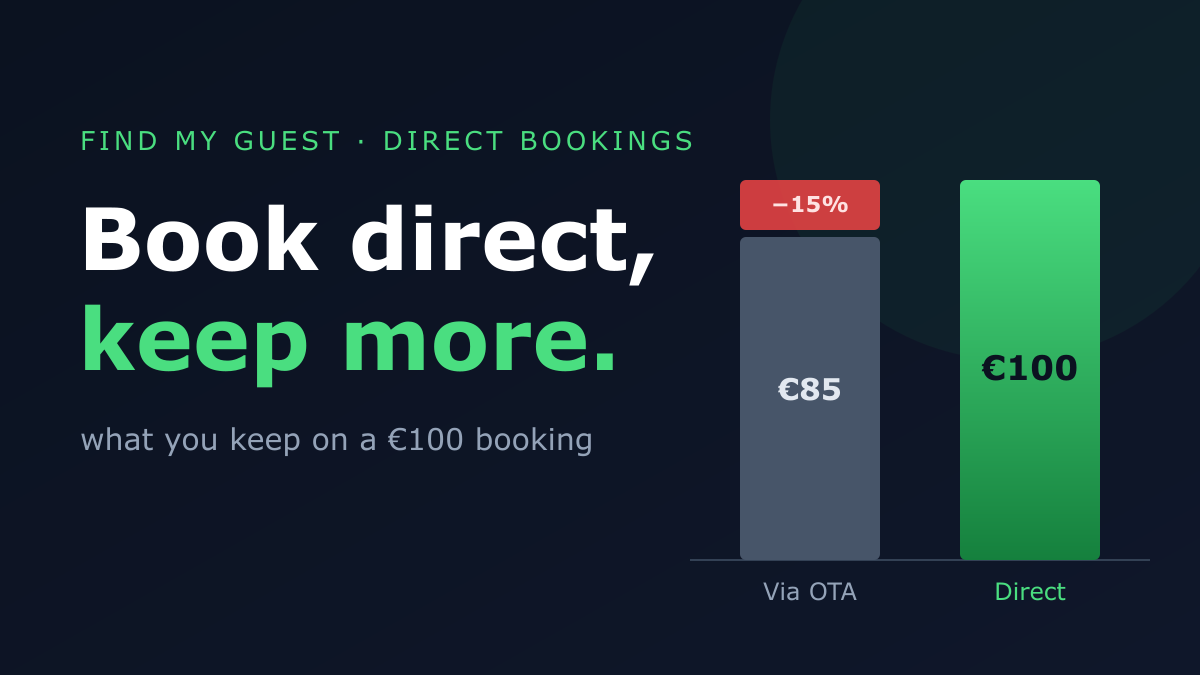
This is the obvious one, and it's big. OTAs typically take 15% to 20% of every
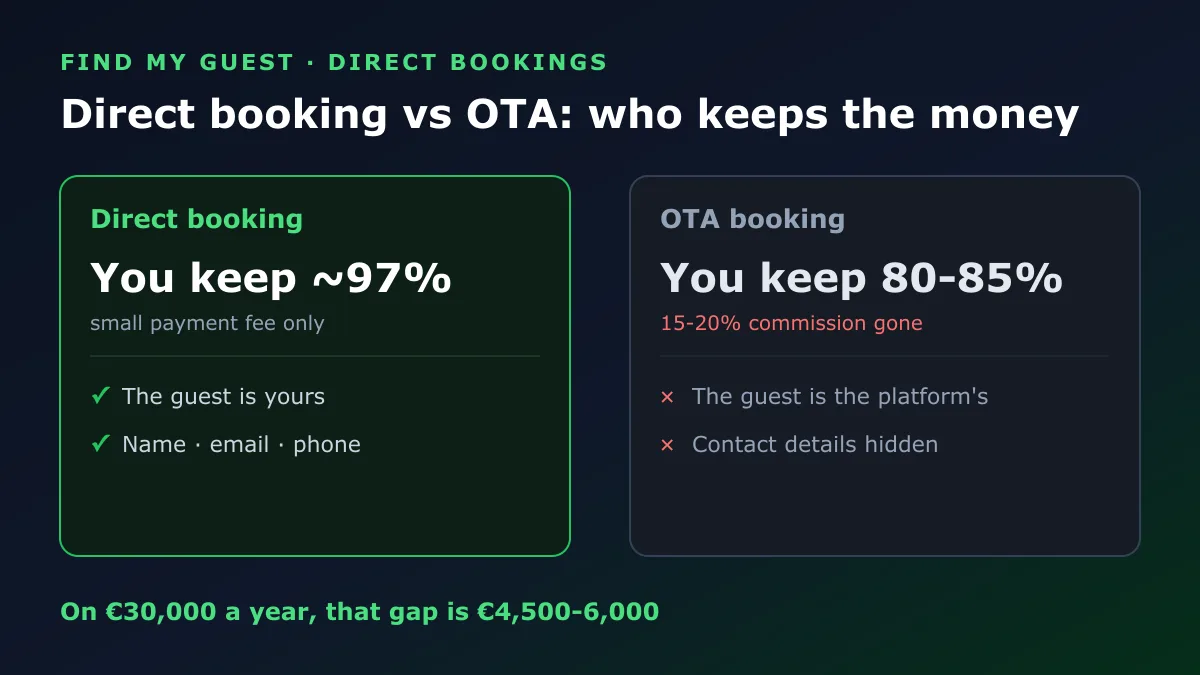
booking, depending on the platform and plan. On €30,000 of yearly revenue,
that's €4,500 to €6,000 handed over · every year, forever. A direct booking keeps
that money in your pocket (minus a small payment-processing fee).
2. Guests are far more likely to come back
When a guest books direct, you own the relationship. You can invite them back next
season, and the repeat stay costs you nothing in commission. On an OTA, the guest
"belongs" to the platform · they'll likely rebook through it (and you'll pay again)
or be shown a competitor next time.
3. You actually have their information
Book direct and you get the guest's real name, email and phone, plus their
preferences. That lets you follow up, send an off-season offer, or simply stay in
touch. Most OTAs deliberately mask contact details and sit between you and the
guest, so you can't build a list you own.
4. You can offer a better price · and still earn more
Because there's no 15-20% middleman, you can share some of that saving with the
guest and still net more than an OTA booking. A "best price when you book
direct" offer is a genuine win-win: cheaper for them, more profit for you.
5. Happy guests refer you
A great stay, a personal touch and a fair direct price are exactly what people
tell friends about. Referrals and word of mouth cost you nothing and convert
better than any ad · and they come back to your site, not a platform's search
results.
6. You're not at the mercy of platform rules
OTAs change commissions, tweak their ranking, adjust cancellation policies and
occasionally suspend accounts · with no notice and no appeal. Every direct booking
reduces that dependence. You set your own terms, your own cancellation policy and
your own communication.
7. You can upsell and build a real brand
On your own site you can offer late checkout, extras, longer stays or a returning-
guest discount · and guests remember you, not a listing among thousands. Over
time that brand is an asset the platforms can't take away.
Direct booking vs OTA, side by side
Here are the seven reasons in one view · the same stay, seen from each channel.
What's at stake
Direct booking
OTA booking
Commission
Small payment fee only
15-20% of every stay
Repeat guests
You invite them back, free
Platform re-charges you
Guest data
Name, email, phone, preferences
Contact details masked
Pricing power
Share the saving, still earn more
Fixed by the platform
Referrals
Come back to your site
Sent to platform search
Rule changes
You set your own terms
Commissions, ranking, bans
Brand
Guests remember you
One listing among thousands
OTAs still have their place
To be fair: OTAs are excellent for discovery and for filling last-minute gaps, and
you shouldn't break their rules (don't divert a guest away from a stay they've
already booked on a platform). The smart play is to treat the OTA as the top of
your funnel · let it introduce new guests, then earn their next stay directly.
How to actually get more direct bookings
Wanting direct bookings isn't enough · travelers have to be able to find and trust
your own site. The essentials:
Be findable. A site that ranks on Google and is readable by AI assistants,
so people discover you outside the platforms (see our
SEO checklist and the
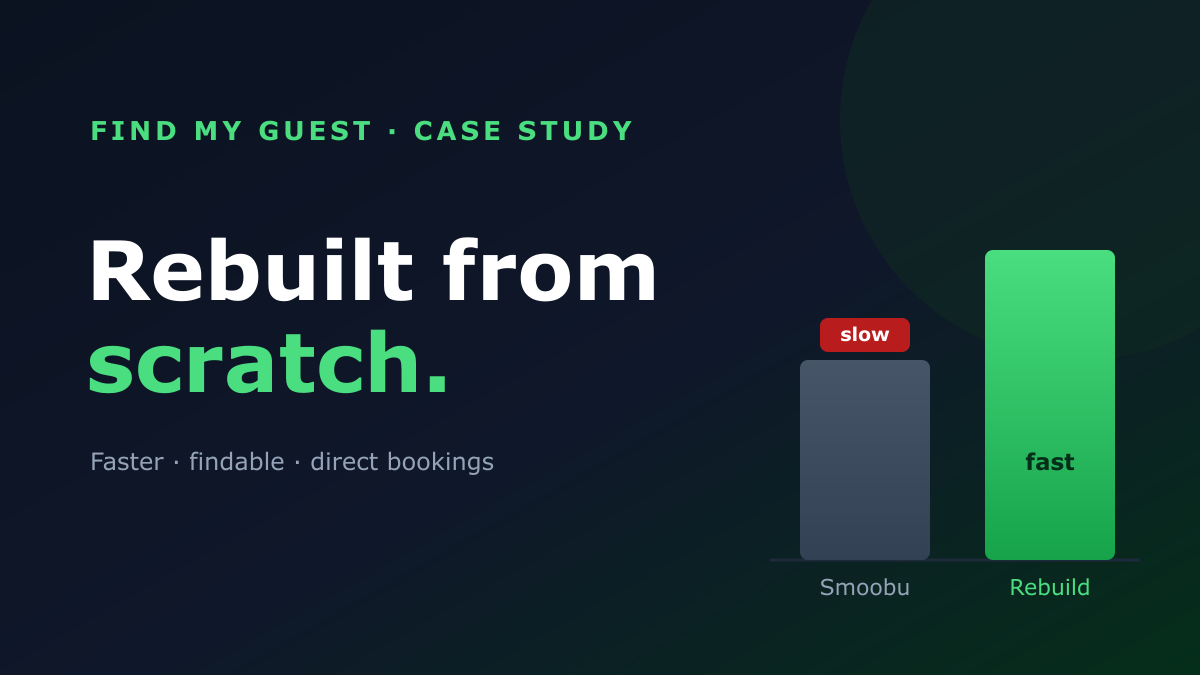
5× views case study).
Make booking effortless. A clear, fast path from "I want this" to "booked".
Give a reason to book direct. A best-price guarantee or a small perk.
Capture the email and follow up. That's how a first stay becomes a second.
Lever
What it does
Where to start
Be findable
Guests discover you outside the platforms
Rank on Google, be readable by AI assistants
Effortless booking
Turns interest into a confirmed stay
A clear, fast path from "I want this" to "booked"
Reason to book direct
Gives the guest a why
A best-price guarantee or a small perk
Capture the email
Turns a first stay into a second
Follow up with an off-season offer
Every one of those is fixable without a developer. The platforms will always be
part of the mix · the goal is simply to stop handing them a cut of guests who
would happily book with you directly.
Good to know
How much commission do OTAs like Airbnb and Booking take?
+
Most OTAs take 15% to 20% of every booking, depending on the platform and plan. On €30,000 of yearly revenue that is €4,500 to €6,000 handed over every year. A direct booking keeps that money, minus only a small payment-processing fee.
Are direct bookings cheaper for the guest?
+
They can be, and still leave you with more profit. Because there is no 15-20% platform commission, you can pass part of the saving to the guest with a best-price offer and still net more than an equivalent OTA booking.
Is it against the rules to take a booking direct instead of through an OTA?
+
No. It is only a problem if you divert a guest away from a stay they have already booked on a platform. Using the OTA to be discovered and then earning the guest's next stay on your own site is completely legitimate.
How do I actually get more direct bookings?
+
Be findable on Google and to AI assistants, make booking effortless, give a clear reason to book direct such as a best-price guarantee, and capture the guest's email so a first stay becomes a second. None of these need a developer.