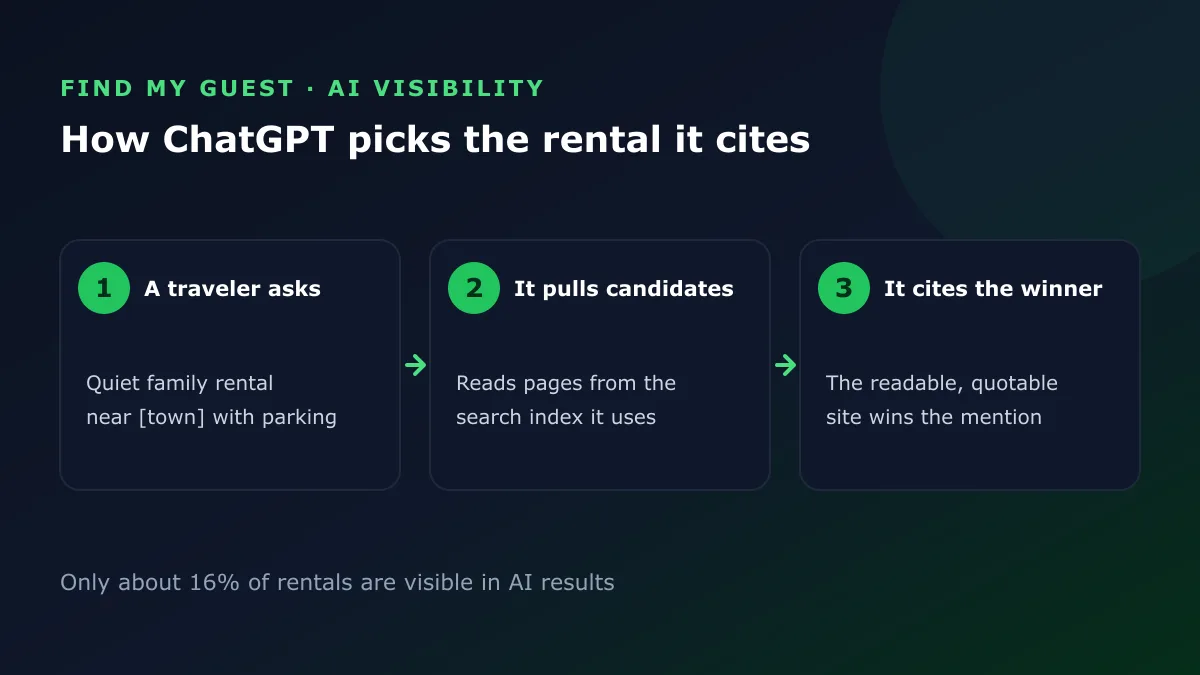
Yes · ChatGPT and other assistants recommend specific places to stay when a traveler asks. Behind that simple answer is a mechanical process: the assistant pulls candidate pages from a search index, reads them, and cites the ones that most clearly and credibly answer the question. So whether it recommends your rental comes down to two things · can it find your content in the index it uses, and once it reads that content, is your place the clear, trustworthy answer? Understanding that pipeline tells you exactly what to fix.
How the assistants actually choose
The engines differ in detail but share a shape:
- ChatGPT search retrieves candidate results from a search provider · notably Bing · then reads and summarizes them, citing sources (OpenAI). If Bing has not indexed you, ChatGPT struggles to surface you.
- Perplexity runs a live retrieval pipeline: it fetches a set of pages per query, then cites a few, favoring clear entities, direct answers and claims corroborated across multiple independent sources.
- Google's AI Overviews and AI Mode draw on Google's own index and, in Google's words, need "no special schema" and no AI-specific files · the same crawlable, helpful content that ranks is what they use (Google Search Central).
The common thread: every assistant depends on an underlying web index, then rewards content it can read with confidence.
| Assistant | Where it gets pages | What it favors when citing |
|---|---|---|
| ChatGPT search | A search provider (notably Bing) | Sources it can read and summarize; must be indexed first |
| Perplexity | Live retrieval, a set of pages per query | Clear entities, direct answers, claims corroborated across sources |
| Google AI Overviews / AI Mode | Google's own index | The same crawlable, helpful content that ranks · no special schema |
What makes content get cited
The one peer-reviewed study of this question tested thousands of queries and found consistent winners. Adding quotations lifted citation by up to ~41%, adding statistics ~31 to 40%, and citing authoritative sources ~30 to 35%. Classic keyword stuffing did nothing, and sometimes hurt (GEO paper, KDD 2024). In plain terms: assistants cite pages that answer directly, in clear prose, with concrete facts and credible references. A vague, adjective-heavy listing gives them nothing to lift.
| What you add to a page | Effect on citation | Why it works |
|---|---|---|
| Direct quotations | Up to ~41% more | Gives the assistant an exact line to lift |
| Concrete statistics | ~31 to 40% more | Verifiable facts read as trustworthy |
| Authoritative sources | ~30 to 35% more | Corroboration the model can point to |
| Keyword stuffing | No gain, sometimes worse | Reads as noise, not an answer |