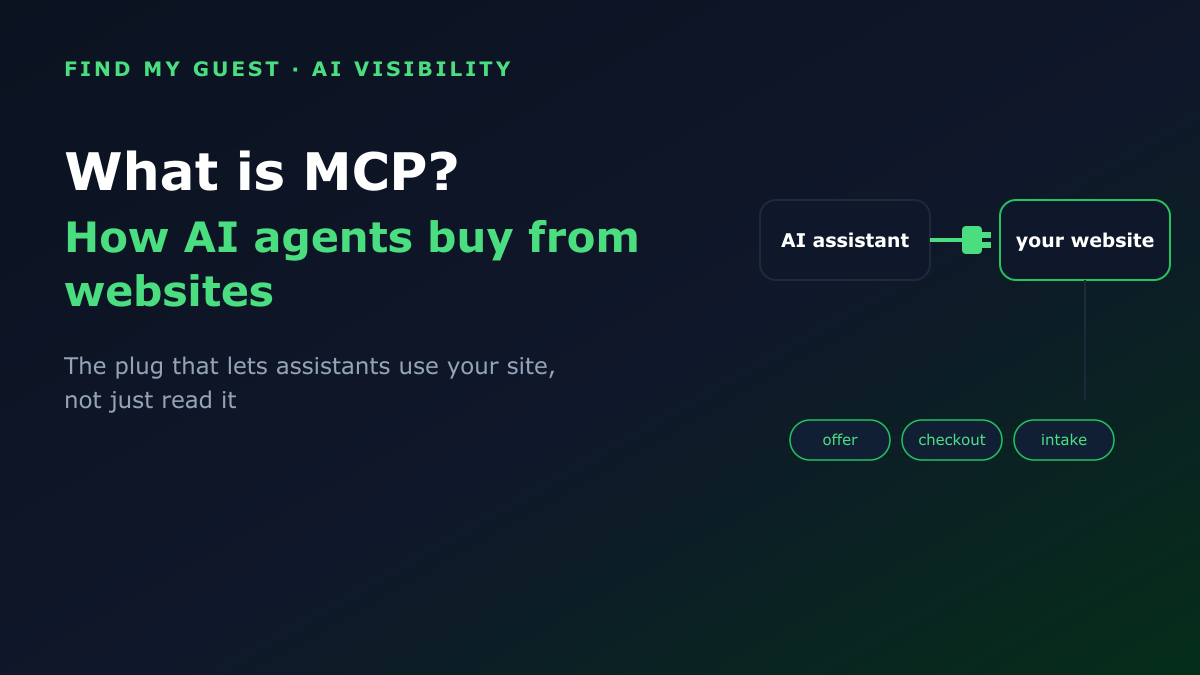
What is MCP? How AI agents read · and now buy from · websites
MCP is the plug that lets AI assistants use a website instead of just reading it. A plain-language explanation of how it works, shown on a real example: our own audit shop, which agents can now operate end to end.
By Find My Guest··5 min read
AI visibilityGEOSEO
AI assistants used to do one thing with a website: read it. In 2026 they do
something much more interesting · they use it. They check availability, fill
forms, open checkouts. The plumbing that makes this possible has a name most
hosts have never heard, and it is quietly becoming as important as Google's
crawler: MCP, the Model Context Protocol.
We just wired our own shop with it (here is that story),
so we can explain it on a live example instead of a whiteboard.
MCP in one metaphor
Think of MCP as a USB port for AI. Your website normally exposes pages ·
things to read. An MCP server exposes tools · things to do. An assistant
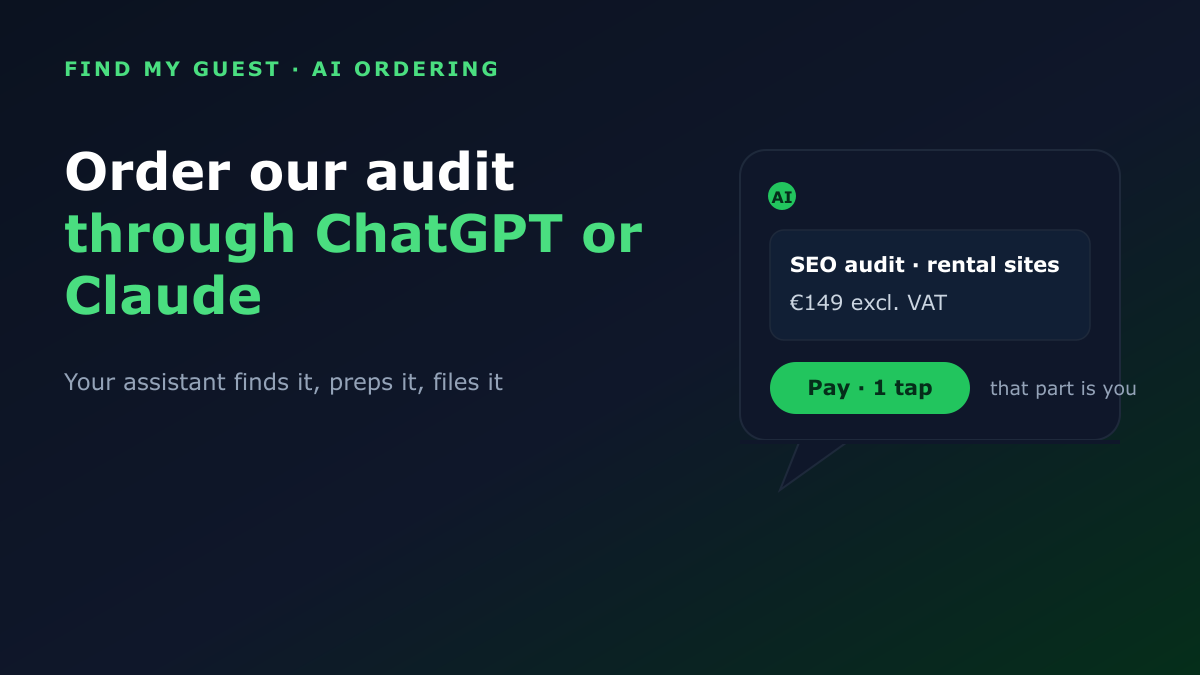
that plugs in gains abilities it did not have: on our server, the ability to
quote our audit, open a checkout and file an intake form.
The protocol is an open standard created by Anthropic and adopted across the
industry, OpenAI included. That matters: you build one server, and every
capable assistant can plug into it.
What actually happens when an assistant plugs in
Under the hood it is a short, polite conversation between two programs:
Step
Who speaks
What is said
1 · Handshake
Assistant → server
"Hello, I speak MCP. Who are you?"
2 · Introduction
Server → assistant
"I am Find My Guest. Payment always stays with the human."
3 · Tool list
Server → assistant
"I offer three tools" · each with a description and expected inputs
4 · The model decides
Assistant, internally
Reads the descriptions like text · calls a tool only when the conversation makes it relevant
5 · Tool call
Assistant → server
"Run get_offer_details in Spanish" · the server executes real code and answers
Step 4 is the part people find surprising. Nobody programs "if the user says
audit, call the tool." The model simply knows what its tools do · from their
plain-text descriptions · and reaches for one the way you reach for a
calculator. The tool description is the interface.
The three tools on our server
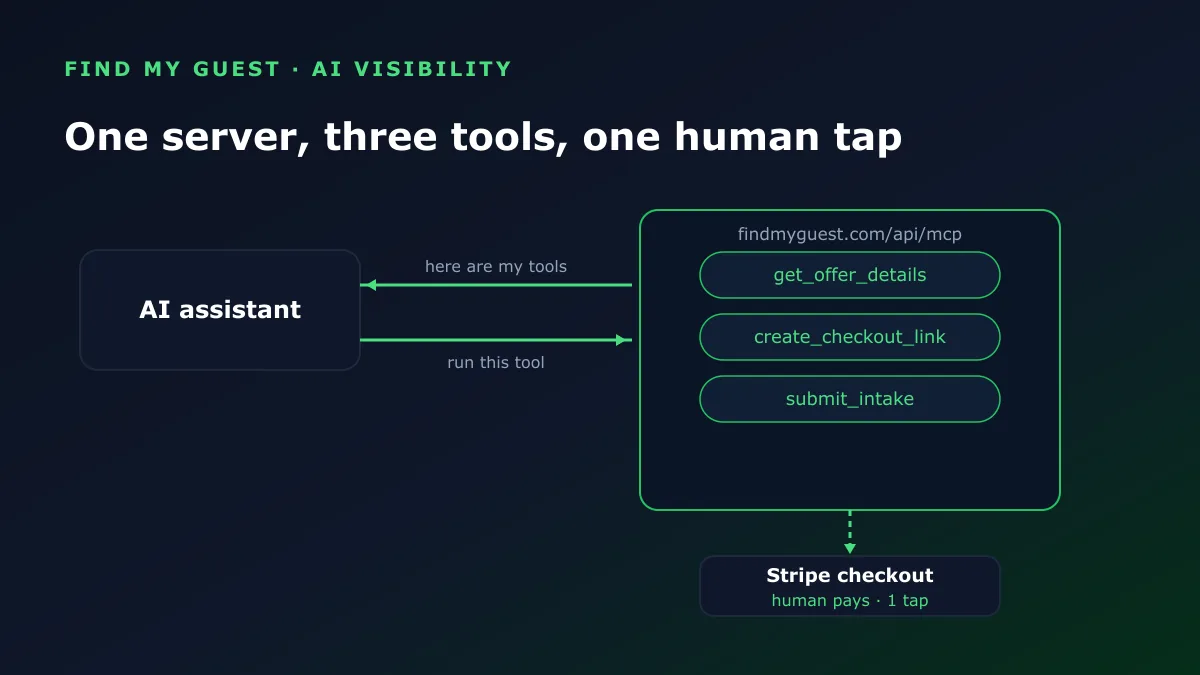
Concrete beats abstract, so here is exactly what findmyguest.com/api/mcp
offers a connected assistant:
Tool
What it does
What comes back
get_offer_details
Reads the audit offer in your language
Price (149 € excl. VAT), scope, delivery time, FAQ
create_checkout_link
Prepares a personal Stripe checkout page
A URL the human opens and pays on
submit_intake
Files the post-purchase brief for a paid order
Confirmation that the audit is underway
Notice what is missing: there is no pay tool. Under EU payment rules (PSD2)
every card payment needs a strong human confirmation, and the major assistants
refuse card entry as policy. Good agentic commerce is not "the AI pays" · it
is the AI prepares everything and the human confirms once.
How do assistants find an MCP server?
Honest answer: mostly through humans, for now.
Web search, today's real channel. Assistants that browse can read a
site's machine documentation · ours announces the MCP endpoint in
llms.txt · and act on what they find.
Manual connection, live today. Any Claude user can paste a server URL
under Settings · Connectors. ChatGPT accepts MCP connectors in developer
mode.
Directories, growing. Anthropic runs a connector directory with
one-click installs; community registries list thousands of public servers.
Automatic discovery, not yet. A standard for "does this domain have an
MCP server?" is still being drafted. We already publish the file it will
look for.
What this means for your rental website
You probably do not need an MCP server this year. You absolutely need what
sits underneath it. When a traveler asks an assistant "find me a house with a
pool near Annecy", the assistant runs the reading half of everything
described above: fetch your pages, extract facts, compare, recommend, link.
Whether your site survives that pipeline is decided by unglamorous things:
Agent-readiness layer
Question it answers
Typical fix
Access
Can agents fetch your pages at all?
Unblock AI crawlers in your firewall or CDN
Legibility
Can they extract prices, places, amenities?
Structured data, clear headings, plain text
Answers
Do your pages answer real traveler questions?
FAQ sections, one clear page per intent
Action
Can a booking or inquiry be completed?
Stable links, forms without traps
We audit exactly those layers · it is the AI-visibility half of
our audit, next to classic SEO. We simply went one step further
on our own shop and added the action layer too. The front door for software is
open; the guests it brings are very much human.
Good to know
What does MCP stand for and who created it?
+
MCP is the Model Context Protocol, an open standard created by Anthropic (the company behind Claude) and since adopted across the industry, including by OpenAI. It defines how an AI assistant connects to an external server and uses the tools that server offers.
Is MCP only for Claude?
+
No. Claude popularized it, but the protocol is open and assistant-agnostic: ChatGPT supports MCP connectors in developer mode, and most agent frameworks speak it. One server can serve them all · ours does.
Does my rental website need an MCP server?
+
Not yet, and maybe never. MCP shines for transactions. What your site needs today is the layer underneath: pages agents can read, structured data, plain-language answers and stable links. That is what determines whether assistants recommend you at all · and it is exactly what our audit measures.
Can an AI agent pay through MCP?
+
Not on our server, and generally not in the EU. Payment requires a human confirmation under EU rules (PSD2), and the big assistants refuse to enter card details anyway. Well-designed MCP commerce tools prepare the payment and let the human make the one confirming tap.