← Back to the blog

What is a GEO audit? AI visibility, explained for short-term rental hosts

A GEO audit checks whether AI assistants like ChatGPT and Perplexity can understand and recommend your booking site. Here is what GEO means, how a GEO audit differs from a classic SEO audit, and what a good one actually checks.

By Find My Guest5 min read
GEOAI visibilitySEO
What is a GEO audit? AI visibility, explained for short-term rental hosts

A GEO audit is a review of how well AI assistants · ChatGPT, Claude, Gemini, Perplexity and Google's AI answers · can read, understand and recommend your website. GEO stands for generative engine optimization: the practice of getting your site cited inside AI-generated answers, not just ranked in a list of blue links. For a short-term rental, a GEO audit asks one question: when a traveler asks an AI where to stay in your area, can the AI confidently put you forward?

GEO vs SEO: the short version

SEO optimizes for a search engine that returns a list of pages. GEO optimizes for an assistant that reads those pages and writes a single answer. They overlap a lot · both reward clear, fast, well-structured sites · but they are not the same job.

SEO audit GEO audit
Optimizes for Google's ranked results AI-written answers
The win You appear in the list You are named in the answer
Cares most about Keywords, links, speed, indexing Clarity, structure, FAQs, identity, trust
Typical question "Do I rank for villa + city?" "Does ChatGPT recommend me for that trip?"
Key signal Backlinks and rankings Machine-readable meaning

The good news for hosts: most GEO improvements also help your classic SEO. Clear structure and a real FAQ make Google happier too. This is why we treat them together rather than as rival projects · see how to be found for the SEO half of the picture.

What a GEO audit actually checks

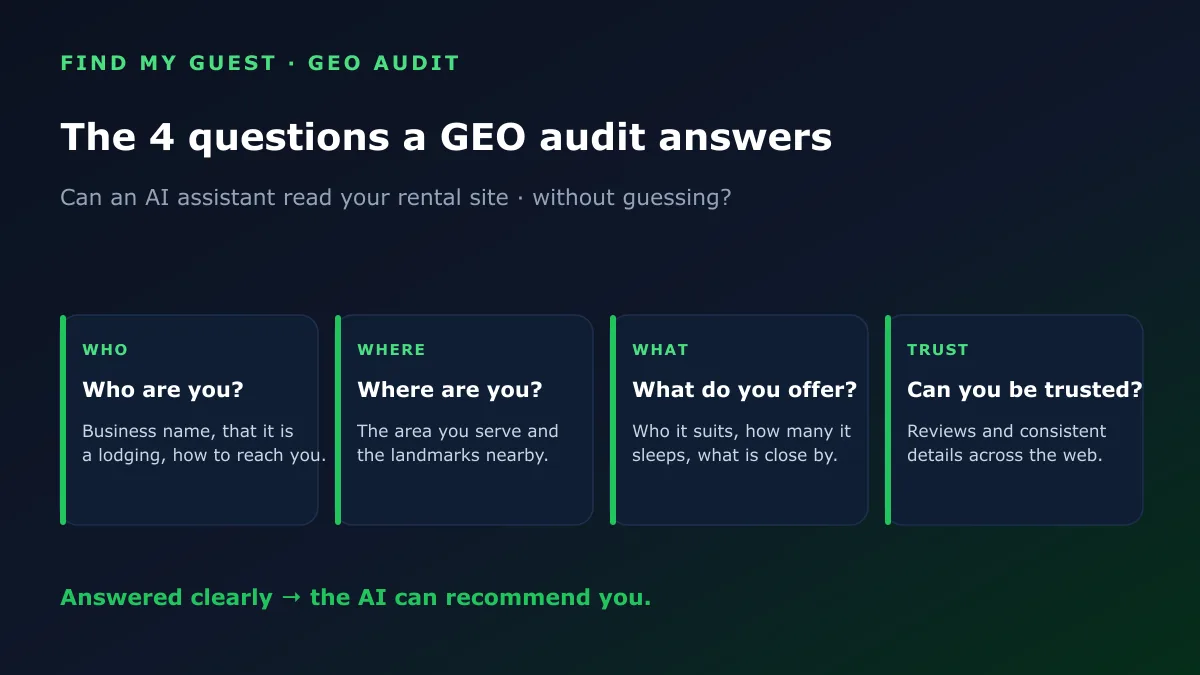
A thorough GEO audit looks at whether a machine can answer four questions about your site without guessing:

Who are you? Does the site clearly state the business name, that it is a lodging business, and how to contact you · in plain text and in structured data?

Where do you operate? Is your location obvious and consistent: the area you serve, nearby landmarks, the city or region a traveler would search for?

What do you offer, exactly? Can the AI tell who the place suits · families, couples, remote workers · how many it sleeps, and what is nearby, without inferring it from photos it cannot read?

Can you be trusted? Are there reviews, consistent details across the web, and a clean profile that back up the claims on the page?

It also checks the technical groundwork that lets assistants read you at all: clean headings, fast pages, an FAQ section, structured data, and content written to match how people actually ask questions rather than marketing slogans.

Question What the AI is checking What makes it fail
Who are you? Business name, that it is a lodging, contact Name buried in an image or logo only
Where are you? Area served, nearby landmarks, region Location only implied by photos
What do you offer? Who it suits, capacity, what is nearby Details left to guess from pictures
Can you be trusted? Reviews, consistent details, clean profile Conflicting facts across the web

The four questions a GEO audit answers about a rental site: who you are, where you are, what you offer, and whether you can be trusted

Why rental sites tend to fail it

Many direct booking sites were built in 2019 to 2021, around the COVID push to escape the OTAs. They were designed as brochures: nice photos, a booking widget, generic copy. That was enough when the only reader was Google's keyword matcher. It is not enough now that the reader might be an assistant trying to summarize you in one sentence. We break down the three most common failures in this audit write-up.

How to run a quick GEO check yourself

You do not need a tool to get a first read. Ask an AI assistant the question your ideal guest would ask · "best family-friendly rental near [your landmark]" · and see if you are mentioned. Then name your property directly and see whether the assistant can describe it correctly. If it can't, the AI literally does not understand your site yet, and that is exactly what a GEO audit fixes.

A full GEO and SEO audit goes much further: we test your site the way these systems read it and hand you a tailored, no-developer plan to close the gaps. If you would rather start on your own, work through our SEO checklist first · it covers the foundations both SEO and GEO depend on.

The takeaway

A GEO audit is simply an honest look at whether machines can understand and vouch for your rental. As more travelers start their search inside an AI assistant, being readable to those assistants stops being optional. Get clear about who you are, where you are and who you are for · and make a machine able to say it back.

Good to know

What is a GEO audit?
A GEO audit is a review of how well AI assistants like ChatGPT, Claude, Gemini and Perplexity can read, understand and recommend your website. GEO stands for generative engine optimization: getting your site cited inside AI answers, not just ranked in a list of links.
What is the difference between a GEO audit and an SEO audit?
An SEO audit optimizes for a search engine that returns a ranked list of pages; a GEO audit optimizes for an assistant that reads those pages and writes a single answer. GEO cares most about clarity, structure, FAQs, identity and trust · the signals a machine needs to name you confidently.
How can I check my GEO visibility myself?
Ask an AI assistant the question your ideal guest would type, such as best family-friendly rental near your landmark, and see if you are mentioned. Then name your property directly and check whether the assistant describes it correctly. If it cannot, the AI does not understand your site yet.
Does GEO replace SEO?
No. GEO and SEO overlap heavily and most GEO improvements also help classic SEO, because clear structure and a real FAQ make Google happier too. Treat them as one project rather than rivals.

Keep reading