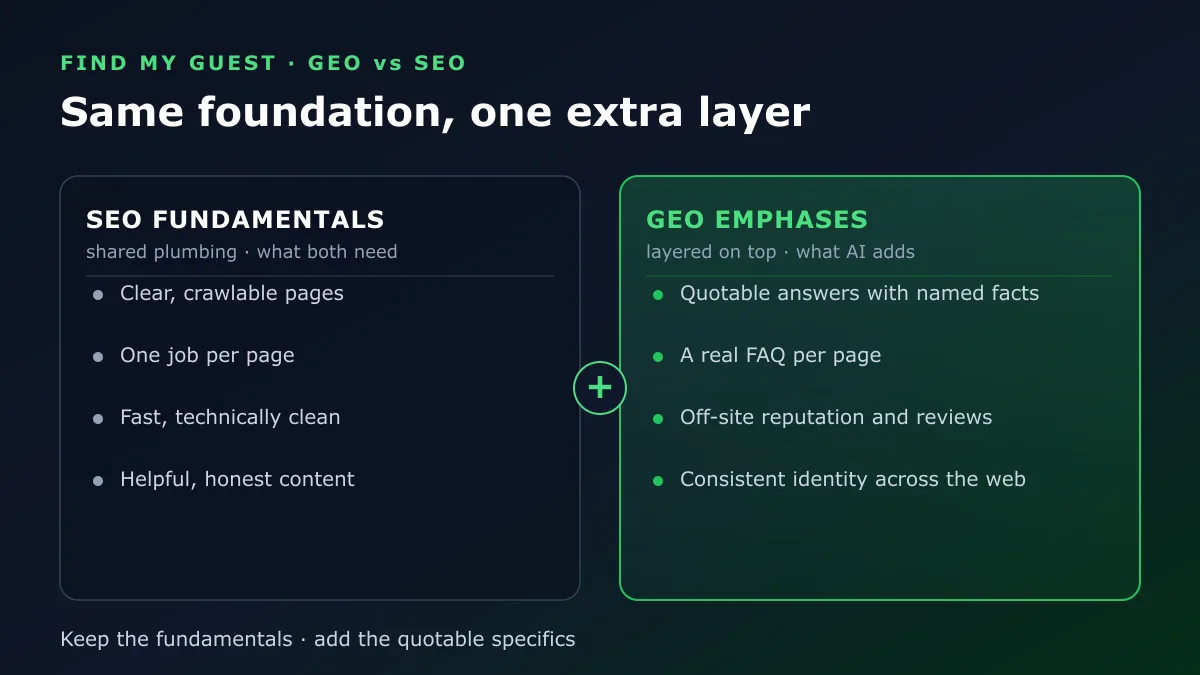
Here is the honest answer before the debate: GEO is not replacing SEO · it is extending it. Generative engine optimization (getting recommended by ChatGPT, Gemini and Perplexity) runs on the same foundations as good SEO · clear, helpful, crawlable content · with a few new emphases. So for a vacation rental host, the right move is not to pick GEO or SEO. It is to keep doing the fundamentals and add the handful of things that make your site quotable by a machine. That reframes the whole Reddit argument.
The Reddit split, fairly represented
Read r/SEO and you will find a loud skeptic camp: GEO is a buzzword, it is "good content plus solid SEO" with a new label, AI search traffic is still tiny next to Google, and nobody should be moving budget yet. Read r/GenEngineOptimization · a subreddit that exists precisely because a believer camp is forming · and you find the opposite energy: this is the next channel, get in early.
Both are partly right, and the data explains why.
The skeptics are right that the plumbing is shared. Google itself says its AI features need no special files or schema and that "AI search is still search" · the same crawlable, helpful content wins (Google Search Central). And the single peer-reviewed study on the topic found that keyword tricks do nothing for AI visibility, while clear writing and credible facts do (GEO paper). That is not a new religion · it is SEO fundamentals with better manners.
The early adopters are right that the behavior is shifting fast. Around 56% of US leisure travelers used AI for a trip in the past year, and search's share of travel research fell from 51% to 36% while AI platforms climbed (Phocuswright, via RevPARGenius). When a channel doubles its audience in a year, "still small" stops being a reason to ignore it.
Here is the debate laid out side by side, and where each camp lands:
| Question | Skeptics (r/SEO) | Early adopters | The honest read |
|---|---|---|---|
| Is GEO a new discipline? | No, rebranded SEO | Yes, a new channel | Same foundation, new emphases |
| Move budget now? | Not yet | Get in early | Sequence, do not switch |
| What wins visibility? | Solid SEO basics | AI-specific tactics | Basics first, quotable specifics on top |
| Is the audience real? | Still tiny | Growing fast | Small but doubling · worth preparing for |
What is genuinely different about GEO
Three emphases separate GEO from classic SEO, and they are the parts worth acting on:
- You want to be quoted, not just ranked. An assistant lifts a sentence and attributes it. So write sentences worth lifting · direct answers with concrete numbers and named facts. These raised AI citation by 30 to 40% in testing.
- Corroboration matters more. AI cross-checks what other sources say about you. Reviews, a clean Google Business Profile and local mentions carry extra weight.
- The unit is the answer, not the keyword. You are optimizing for "quiet family rental near [town] with parking", phrased as a question, not for a keyword string.
We go deeper on the mechanics in what a GEO audit is.