← Back to the blog

I audited dozens of direct booking websites · the 3 most common mistakes

After auditing dozens of direct booking sites for vacation rental hosts, the same three issues kept coming up: messy H1 headings, no readiness for AI search, and missing business-identity structured data. Here is what they are and how to fix each one.

By Find My Guest6 min read
SEOstructured dataAI visibility
I audited dozens of direct booking websites · the 3 most common mistakes

Across dozens of direct booking websites I audited for vacation rental hosts and property managers, the same three mistakes came up again and again: confused or duplicated H1 headings, no readiness for AI search, and missing business-identity structured data. None of these sites were bad · most had good photos, a booking engine and some SEO basics. They were just built for a version of the internet that existed a few years ago.

Here are the three issues, why each one quietly costs bookings, and how to fix it.
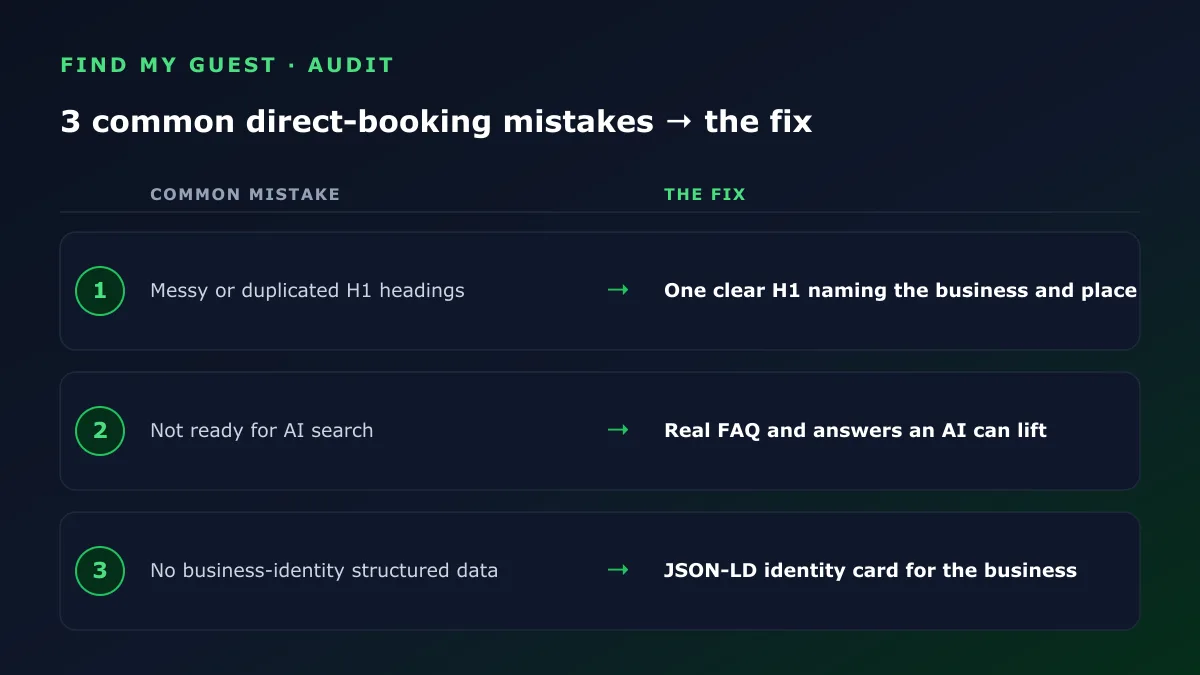
The three most common direct booking website mistakes, each paired with its fix: one clear H1, a real FAQ for AI search, and JSON-LD business-identity structured data

1. H1 headings were a mess almost everywhere

This was the most common issue by far. Sites either had several H1 tags on one page, or a single H1 that said nothing useful.

The H1 is the main heading of a page · the one-line answer to "what is this page about?" On a lot of rental sites it read like a slogan:

"Welcome to our website"

or

"Your perfect stay starts here"

That looks nice, but it tells Google and AI tools nothing. For a direct booking site, the homepage H1 should usually answer what the business is and where it is:

"Vacation Rentals in [Location]"

or

"Boutique Holiday Apartments in [City]"

Weak H1 (says nothing) Strong H1 (names business and place) Why the strong one wins
Welcome to our website Vacation Rentals in Biarritz Tells Google and AI what the page is and where
Your perfect stay starts here Boutique Holiday Apartments in Biarritz Matches how guests actually search
Book now Seafront Apartments near Biarritz Beach One clear intent per page, no ambiguity

The other problem was multiple H1s, usually because of how the template was built · the logo, the hero text, listing titles and the page title were all marked up as H1. It is not always catastrophic, but it muddies the signal. The fix: one clear, descriptive H1 per page that names the business and the place. Our SEO checklist covers the rest of the heading structure underneath it.

2. Almost none were ready for AI search

Many hosts told me their site was built in 2019, 2020 or 2021 · the COVID-era push to depend less on Airbnb, Booking and Vrbo. That makes sense. The problem is that search has changed since, and most of these sites were built for classic SEO only, not for AI discovery.

Almost none had the things an assistant needs to understand them:

  • a real FAQ answering the questions guests actually ask
  • clear information about who the business is
  • explicit property and location context
  • answers structured so an AI can lift them cleanly
  • an llms.txt file or similar AI-readable guidance
  • content written to match specific search intent

Travelers now ask ChatGPT, Gemini or Perplexity things like "where should I stay in [location] with kids?" or "best vacation rentals near [landmark]". If your site can't give clear, structured answers, the AI recommends someone else. Many direct booking sites still read like brochures · nice photos, generic text, a booking widget, not much else. That was enough a few years ago. It probably isn't now. I go deeper on this in how to get recommended by AI.
3. Almost every site was missing business-identity structured data

This was the biggest missed opportunity. Almost none of the sites carried a proper "business identity card" in their code, using JSON-LD structured data.

For a vacation rental business, that card should tell Google and other systems:

  • the business name
  • the type of business
  • the location served
  • the website URL
  • contact information
  • social profiles and sameAs links
  • the logo
  • lodging-business details where relevant

In plain terms, this is what tells a search engine or AI that your website represents a real lodging business in a real place · not a random collection of pages. It matters especially for direct booking sites, because trust is half the conversion problem: guests already know Airbnb and Booking, but not your independent site. Anything that helps machines understand your brand, location and identity is worth doing properly · and it is exactly the kind of signal that earns direct bookings over OTAs.

The general takeaway

Most of these direct booking sites were not bad. They had decent visuals, some SEO basics, a booking engine and property pages. They were just missing the deeper technical and content signals that make a site understandable to Google, to AI tools and to potential guests.

If you already have a direct booking website, these are the three things worth checking first:

  1. Does each important page have one clear, useful H1?
  2. Does the site answer real guest questions clearly?
  3. Does the site have structured data that identifies the business?

Here are the three mistakes side by side with the fix and why it matters:

Common mistake The fix Why it matters
Messy or duplicated H1 headings One clear H1 per page naming the business and place Google and AI understand what each page is about
Not ready for AI search Real FAQ and answers an assistant can lift cleanly ChatGPT, Gemini and Perplexity can recommend you
Missing business-identity structured data JSON-LD identity card for the lodging business Search engines trust you as a real business in a real place

None of this replaces good photos, fair pricing, strong reviews or a smooth booking flow. But if the site itself is unclear to search engines and AI, it is leaving visibility · and bookings · on the table. If you would like a second pair of eyes, that is exactly what our audit does: we check all three (and more) and hand you a plan tailored to your tool.

Good to know

What are the most common direct booking website mistakes?
Across dozens of audits, three came up again and again: messy or duplicated H1 headings, no readiness for AI search, and missing business-identity structured data. Most sites had good photos and a booking engine · they were just built for an older version of search.
How many H1 headings should a page have?
One. A page should carry a single, clear H1 that names the business and the place, such as Vacation Rentals in a given town. Multiple H1s or a vague slogan H1 muddy the signal for Google and AI tools.
How do I make my direct booking site ready for AI search?
Give assistants what they need to understand and quote you: a real FAQ answering guest questions, clear information about who the business is, explicit property and location context, and answers structured so an AI can lift them cleanly.
What is business-identity structured data and why does it matter?
It is a JSON-LD identity card in your code that states the business name, type, location served, URL, contact details, social profiles and logo. It tells search engines and AI that your site is a real lodging business in a real place, which builds the trust that drives direct bookings.

Keep reading