How to get your vacation rental website recommended by ChatGPT, Claude and Perplexity
Travelers now ask AI assistants where to stay. To be the answer, your booking site has to be readable by machines: clear structure, a real FAQ, structured data and content that matches how people actually ask. Here is how to earn those recommendations.
By Find My Guest··6 min read
AI visibilityGEOdirect bookings
To get your vacation rental recommended by an AI assistant, your website has to be
easy for a machine to read and trust: one clear topic per page, plain answers to
the questions travelers actually ask, and structured data that states who you are
and where you operate. AI tools recommend the places they can understand with
confidence · so the work is making your site unmistakably clear.
That short paragraph is the whole answer. The rest of this guide explains how to
put it into practice on a real booking site, even without a developer.
Why this matters now
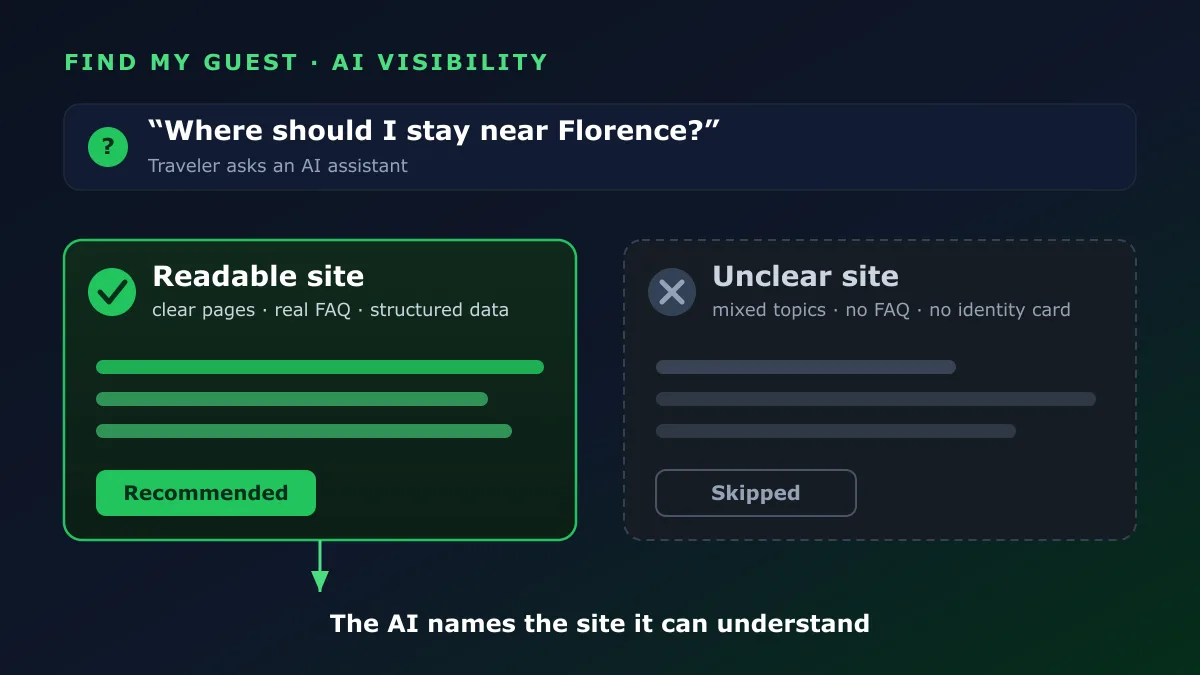
Your future guests no longer rely on Google alone. They ask ChatGPT, Claude,
Gemini or Perplexity things like "where should I stay in the Dordogne with kids?"
or "best villa with a pool near Florence". The assistant reads the web, then names
a handful of places. If it can't understand your site, it recommends your
competitors instead · and you never even saw the search.
This is the same shift we cover in how to be found,
applied to a new front door. Traditional SEO got you into Google's results. AI
visibility · often called GEO, generative engine optimization · gets you into the
answer itself.
Dimension
Traditional search (SEO)
AI answer (GEO)
What you win
A spot in a list of links
A named mention inside the answer
What the machine reads
Keywords and page rank
Plain answers, FAQ, structured data
What the guest sees
Ten blue links to choose from
A short shortlist, already chosen
Your job
Rank on the page
Be the place the model can understand
1. Give every page one clear job
An AI assistant has to summarize your page in a sentence. If your homepage is
trying to be about everything · the region, five properties, your story, last
year's blog · it summarizes to mush. Decide what each page is for, say it in the
heading, and keep the page about that. One page, one job.
2. Answer real guest questions, in plain words
Assistants quote the page that answers the exact question. So write the questions
out, the way a guest would type them, and answer each one directly underneath:
Is the apartment good for families with young children?
How far is it from the beach, and is there parking?
What is check-in like, and can I arrive late?
Is it walkable to restaurants, or do I need a car?
A genuine FAQ section, with one clear answer per question, is the single
highest-leverage thing most rental sites are missing. It maps perfectly onto how
people prompt an AI.
3. Lead with the answer, then explain
Machines (and skim-reading humans) grab the first sentence under a heading. Put
the answer there, then add the colour. "Yes · the villa sleeps eight across four
bedrooms, with a travel cot available" beats a paragraph that buries the number in
the third line.
4. State who and where you are, in structured data
This is the part almost no host gets right. Behind the scenes, your site should
carry a small machine-readable "identity card" (JSON-LD structured data) that
spells out your business name, the type of business, the location you serve, your
URL, contact details and logo. It is invisible to guests but it is exactly what
search engines and AI systems read to decide you are a real lodging business in a
real place · not a random page. We go deeper on this in
the 3 most common mistakes.
5. Be consistent everywhere
If your name, address and description differ between your site, your Google
Business Profile and your social profiles, you look less trustworthy to both Google
and AI. Pick one version of the truth and repeat it everywhere. Consistency is a
trust signal machines can measure.
6. Earn mentions off your own site
AI assistants weigh what other sources say about you. Reviews, a clean Google
Business Profile, a mention in a local guide · these all feed the model's picture
of you. Strong, specific reviews are especially
useful, because they are exactly the kind of quote an assistant reaches for when
it recommends a place.
Here is the whole playbook at a glance · six signals, and the one question each
one answers for the assistant.
Signal
What to do
What it tells the AI
One job per page
Give each page a single clear topic
What this page is about, in one line
Real FAQ
Answer guest questions in plain words
Whether you match the exact question asked
Answer first
Lead with the answer, then explain
The fact it can quote, up front
Structured data
Add a JSON-LD identity card
That you are a real lodging in a real place
Consistency
Same name, address, description everywhere
That you are trustworthy
Off-site mentions
Reviews, Google profile, local guides
What others say about you
How to check where you stand
Open ChatGPT or Perplexity and ask the question a guest would ask about your area.
See who gets named. Then ask it directly about your property by name and see
whether it can describe you correctly · or at all. That five-minute test usually
makes the gap obvious.
Closing that gap is precisely what our audit is for: we check your site for
Google and AI, then hand you a step-by-step plan tailored to your tool
(WordPress, Wix, Divi and others), doable without a developer. If you would rather
start yourself, our SEO checklist is a
good first pass.
The takeaway
Getting recommended by AI is not a trick or a trend to chase. It is the same goal
hosts have always had · be the obvious, trustworthy answer when someone is looking
for a place to stay · expressed in a way machines can read. Make your site clear,
answer real questions, prove who you are, and the assistants will have everything
they need to put you forward.
Good to know
How do I get my vacation rental recommended by ChatGPT or Perplexity?
+
Make your site easy for a machine to read and trust: one clear topic per page, plain answers to the questions guests actually ask, and structured data that states who you are and where you operate. AI assistants recommend the places they can understand with confidence.
What is GEO, and how is it different from SEO?
+
SEO gets you into a list of search results; GEO (generative engine optimization) gets you into the AI's answer itself. GEO leans harder on plain-language answers, a real FAQ and structured data, because those are what assistants quote directly.
Does a FAQ section really help with AI visibility?
+
Yes. A genuine FAQ maps directly onto how people prompt an assistant, so it is one of the highest-leverage additions most rental sites are missing. Write the questions the way a guest would type them and answer each one directly underneath.
How can I test whether AI assistants already know my rental?
+
Open ChatGPT or Perplexity and ask the question a guest would ask about your area, then see who gets named. Next, ask directly about your property by name and check whether it can describe you correctly · or at all. That five-minute test usually makes the gap obvious.