GEO for vacation rentals: how to get cited by ChatGPT, Gemini and Perplexity
Generative engine optimization is how you get your rental named when a traveler asks an AI where to stay. This is the practical playbook for a lodging site, grounded in what the research and the platforms actually say.
By Find My Guest··5 min read
GEOAI visibilitydirect bookings
Generative engine optimization (GEO) for a vacation rental means making your site
the answer an AI assistant gives when a traveler asks where to stay. The playbook
is short and evidence-backed: be crawlable so the engines can read you, write clear
pages that answer real questions with quotable facts, prove who and where you are,
and earn corroboration from other sites. Do those and you are doing 90% of GEO. The
rest of this guide turns each into something you can act on this week.
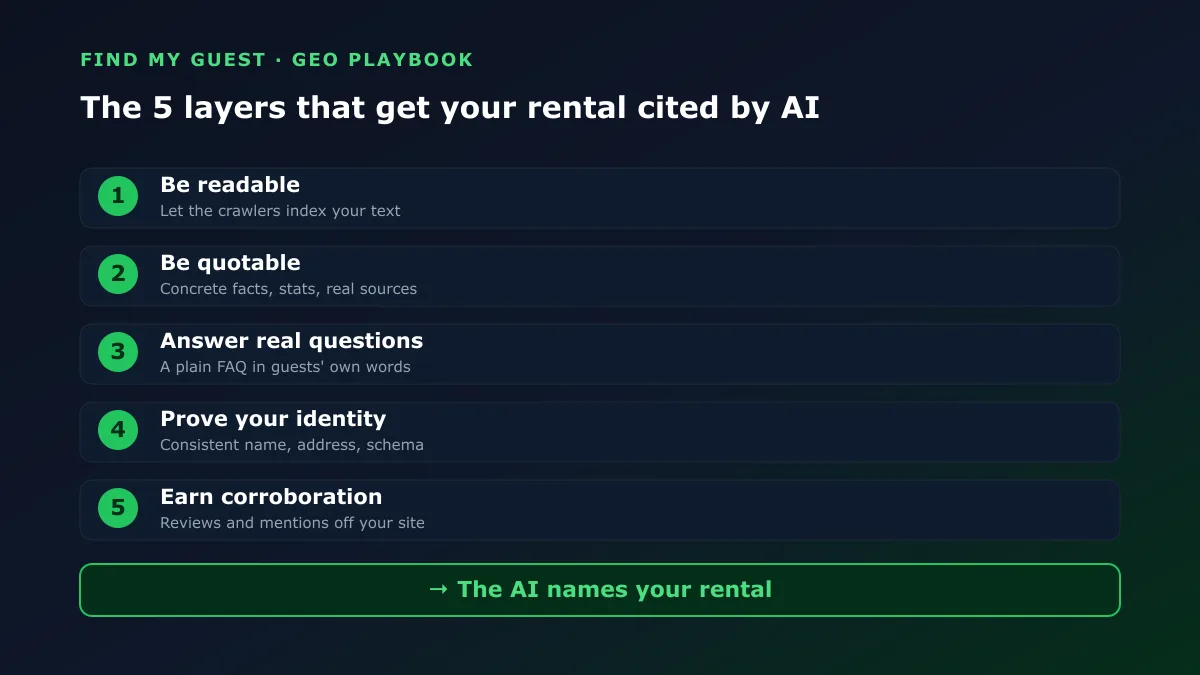
Layer
What it means
The move for a rental
1. Readable
Crawlers can index your text
Allow crawling, keep content in text
2. Quotable
Facts an engine can lift
Concrete specifics, stats, real sources
3. Answers questions
Matches what guests ask
A plain FAQ in guests' own words
4. Proven identity
Machines know who you are
Consistent name, address, schema
5. Corroborated
Others confirm you
Reviews, GBP, local guide mentions
1. Be readable by the machines first
Every assistant sits on top of a search index · ChatGPT leans on Bing, Google's AI
features on Google. If those crawlers cannot read you, no amount of clever content
helps. Google's own guidance is refreshingly plain: allow crawling, link your pages
together, and keep important content in text rather than trapped in images or
scripts (Google Search Central).
Verify your site in both Google Search Console and Bing Webmaster Tools so you know
you are indexed.
2. Write to be quoted, not just to rank
This is the heart of GEO. The peer-reviewed research found that adding quotations,
statistics and citations to credible sources each lifted AI citation by roughly 30
to 41%, while keyword stuffing did nothing (GEO paper, KDD 2024).
For a rental, that means:
Lead each section with the answer, then explain.
Use concrete, verifiable specifics · "9 minutes' walk to the old port", "sleeps 8
across 4 bedrooms with a travel cot", "free parking for two cars".
Reference real local facts and link to authoritative local sources.
3. Answer real guest questions in plain words
Assistants quote the page that answers the exact question. Write a genuine FAQ in
the words guests use · parking, check-in and late arrival, family suitability,
distance to the beach, pets, cancellation. Note that Google retired the FAQ rich
result in 2023, so this is not about markup for a badge · it is that the plain Q&A
content is exactly what AI systems lift (Google Search Central).
4. Prove who and where you are
Give the engines an unambiguous identity. Use LodgingBusiness or LocalBusiness
structured data with a consistent name, address and geo-coordinates, and keep that
name, address and phone identical on your site, your Google Business Profile and
every directory · NAP consistency is a well-established local ranking factor
(BrightLocal). One caveat worth
knowing: Google's dedicated VacationRental rich result is gated to Hotel Center
partners, so treat schema as "help machines understand my business", not a
guaranteed rich card. Structured data is not required to appear in AI answers · it
just makes you easier to parse.
5. Earn corroboration off your own site
Assistants weigh what independent sources say about you. Strong, specific reviews, a
clean Google Business Profile and mentions in reputable local guides give the model
confirmation it can cite. This is the off-site half of getting recommended by
AI, and it compounds over time.
How this differs from plain SEO
If it sounds a lot like good SEO, that is because GEO shares the foundation · we
unpack the relationship in what a GEO audit is. The
new emphases are being quotable, being corroborated, and optimizing for whole
questions rather than keywords. Get the SEO base right, then add these.
Aspect
Plain SEO
GEO adds
Goal
Rank in the blue links
Get named in the AI answer
Content
Match keywords
Be quotable and answer whole questions
Trust signal
Backlinks
Corroboration from independent sources
Unit of intent
The keyword
The real question a traveler types
Do it with an audit
If you would rather not work through five layers alone, our audit checks your
site for Google and AI in one pass and returns a prioritized, developer-free plan
tuned to your platform.
The takeaway
GEO for vacation rentals is not a dark art · it is clarity, made machine-readable.
Be indexable, write quotable answers to real questions, prove your identity, and
collect off-site trust. That is what turns "the AI never mentions us" into being the
place it recommends.
Good to know
What is GEO for a vacation rental?
+
GEO (generative engine optimization) is making your rental site the answer an AI assistant gives when a traveler asks where to stay. In practice it means being crawlable, writing quotable pages that answer real questions, proving who and where you are, and earning corroboration from other sites.
How do I get ChatGPT or Perplexity to cite my rental?
+
Write pages that are easy to quote: lead with the answer, use concrete verifiable specifics, and reference credible local sources. Peer-reviewed research found that adding quotations, statistics and citations each lifted AI citation by roughly 30 to 41%, while keyword stuffing did nothing.
Do I need structured data (schema) to appear in AI answers?
+
No. Structured data is not required to be cited in AI answers · it just helps machines parse your business. Google's dedicated VacationRental rich result is also gated to Hotel Center partners, so treat schema as clarity for the engines, not a guaranteed rich card.
Is GEO different from SEO?
+
GEO shares the same foundation as good SEO, so the technical base still matters. The new emphases are being quotable, being corroborated by independent sources, and optimizing for whole questions rather than single keywords.